
Emotional intelligence across four cornerstones
EQEmotional Intelligence
The capacity to recognize, understand, and work with emotions -- in yourself, with one other, inside a group, and in contact with the vast and uncontrollable.
Daily intelligence briefing
Latest content from voices in this domain.
Listen
A short audio introduction.

Core concept
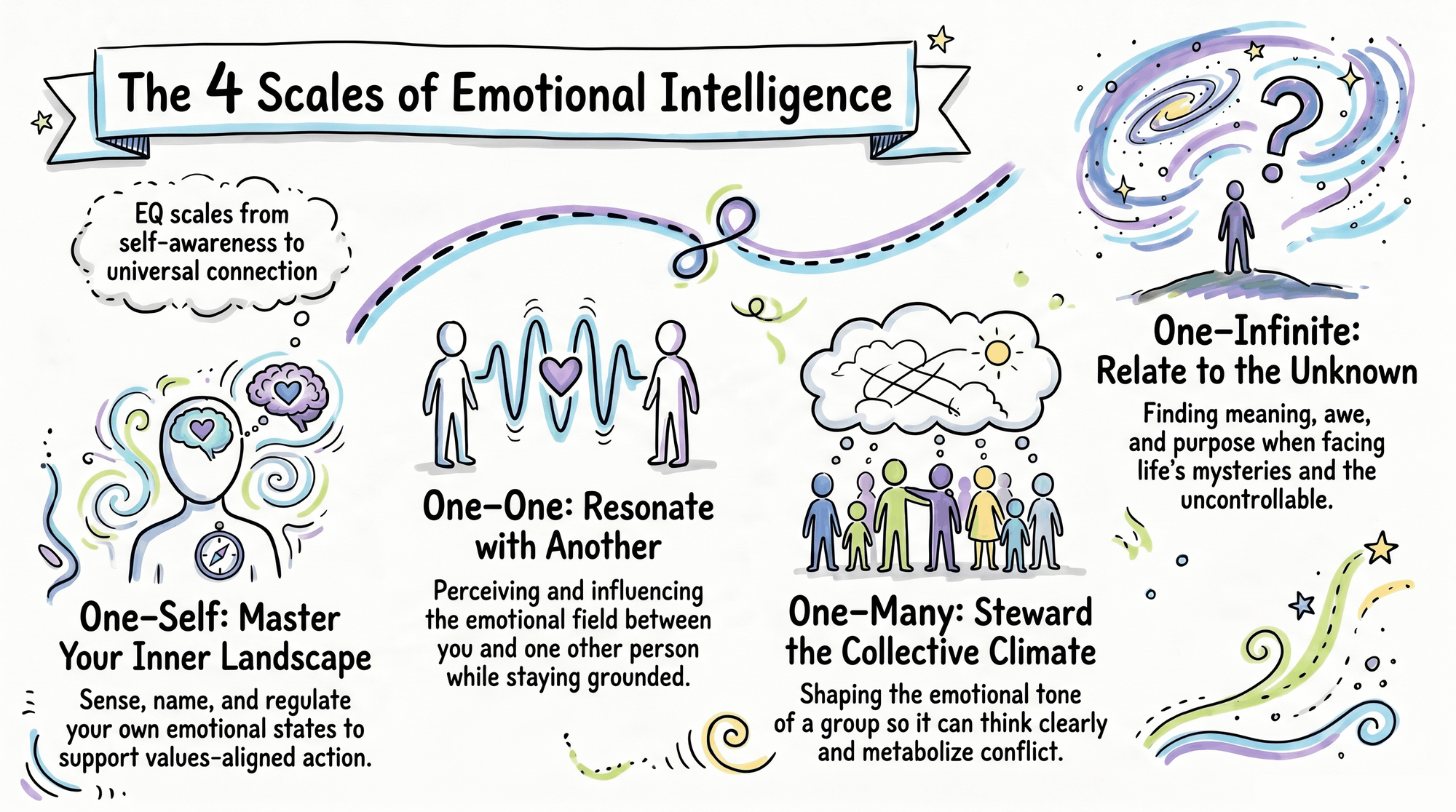
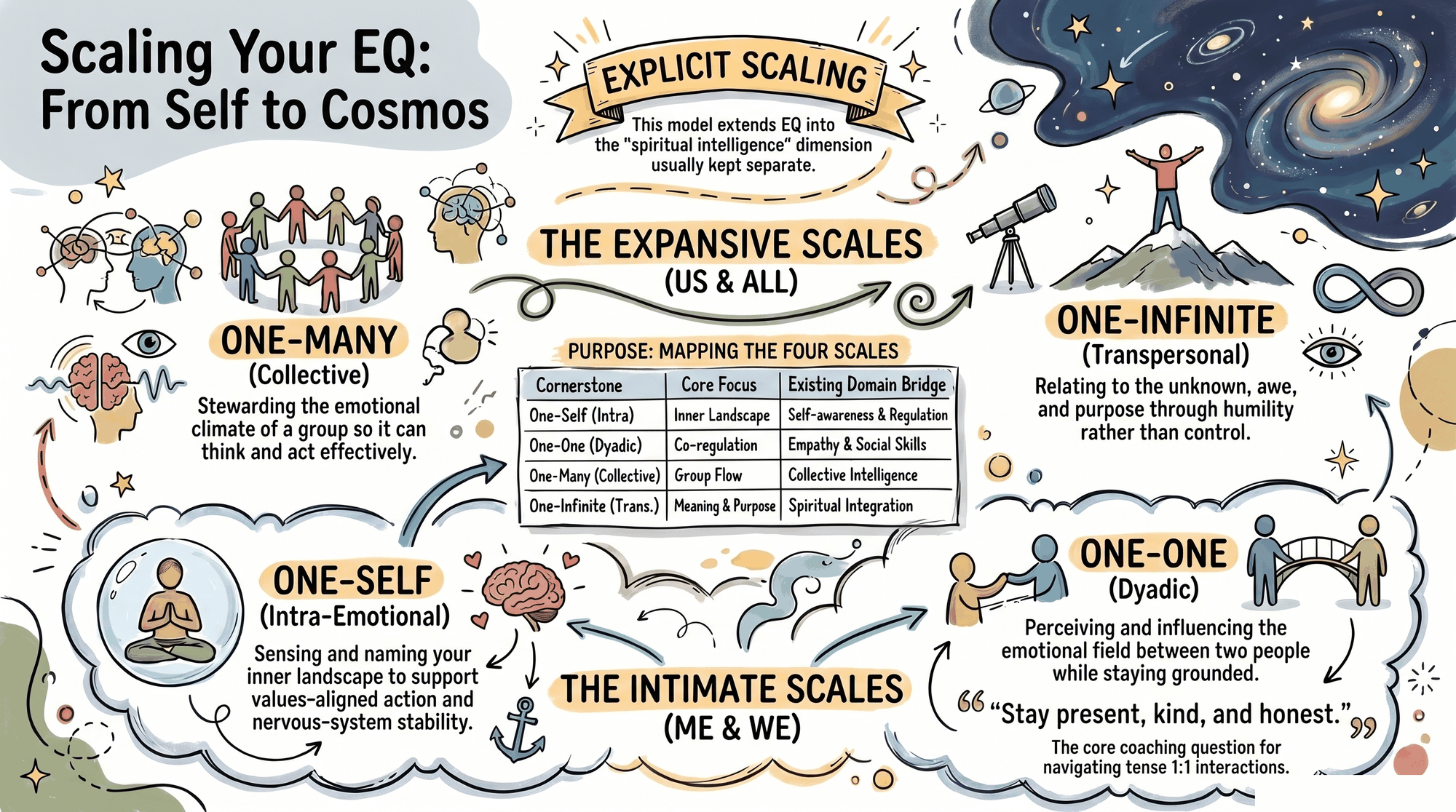
Emotional intelligence, as developed in this framework, scales across four cornerstones: intra-emotional (One-Self), dyadic (One-One), collective (One-Many), and transpersonal (One-Infinite). These map onto and extend the classical Goleman / Salovey-Mayer domains of self-awareness, self-regulation, empathy, and relationship management.
Cornerstone 1 -- One-Self (intra-emotional). The capacity to accurately sense, name, and work with your own emotional states in real time, in ways that support values-aligned action and nervous-system stability. Key capacities: emotional self-awareness, self-regulation and recovery, inner motivation and attitude.
Cornerstone 2 -- One-One (dyadic). The capacity to perceive, resonate with, and influence the emotional field between yourself and one other person while staying grounded. Key capacities: empathic attunement, co-regulation, and relational repair.
Cornerstone 3 -- One-Many (collective). The capacity to sense, shape, and steward the emotional climate of a group so it can think clearly, act effectively, and metabolize conflict. Key capacities: climate sensing, norm setting, and group regulation.
Cornerstone 4 -- One-Infinite (transpersonal). The capacity to feel and relate to emotions that arise in contact with the unknown, the vast, and the uncontrollable -- death, mystery, awe, purpose, the sacred -- and to let these inform wise action rather than collapse or bypass.
Together the cornerstones form a coach-friendly scaling from self to cosmos, with an explicit transpersonal emotional field as the fourth layer.
Featured voices
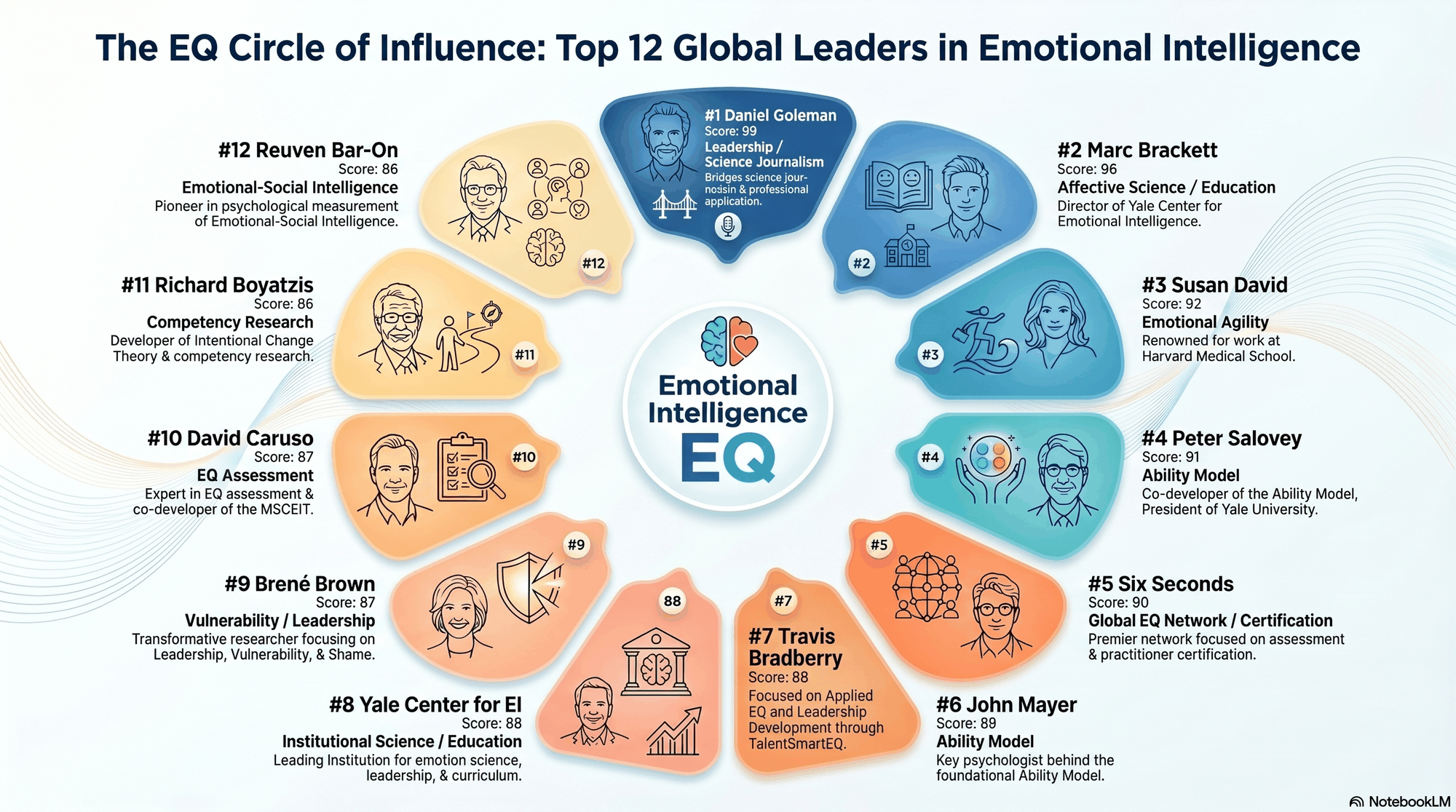
Proof sources backing this intelligence -- a visual rollup of the public thinkers, researchers, and practitioners whose work underwrites the framework.
Graphics
Top thought leaders of Emotional Intelligence
Podcasts, articles, social reach, books and research papers with direct links to the 'top thought leader websites' for your easy reference. Or scroll down on this site to view some of the very best videos as 'Featured Talks'. All of this content is curated and kept current.
| # | Name | Domain | Score | Primary contribution | Website |
|---|---|---|---|---|---|
| 1 | Daniel Goleman | Psychology / Leadership / Science Journalism | 99 | Made emotional intelligence globally legible for business, coaching, and leadership by organizing the field into applied competencies such as self-awareness, self-management, social awareness, and relationship management. | link |
| 2 | Marc Brackett | Affective Science / Education / Yale Center for Emotional Intelligence | 96 | Built one of the field's most robust real-world implementation systems through RULER, making EQ measurable, teachable, and scalable in schools and organizational learning contexts. | link |
| 3 | Susan David | Psychology / Emotional Agility / Harvard Medical School | 92 | Extended EQ beyond "positive thinking" by showing that emotional skill includes facing difficult feelings honestly, with flexibility, self-compassion, and values-based action. | link |
| 4 | Peter Salovey | Psychology / Ability Model of Emotional Intelligence | 91 | Co-originated the ability model that gave EQ conceptual rigor and helped distinguish emotional intelligence from looser self-help formulations. | link |
| 8 | Six Seconds | Global EQ Network / Assessment / Certification | 90 | Scaled EQ into a practical global movement by combining assessment, certification, applied curriculum, and a recognizable developmental model. | link |
| 5 | John Mayer | Psychology / Ability Model of Emotional Intelligence | 89 | Co-developed the scientific basis for treating emotional intelligence as a measurable form of reasoning with emotional information. | link |
| 9 | Travis Bradberry | Applied EQ / Leadership Development / TalentSmartEQ | 88 | Turned EQ into a mass-market management skill set by pairing accessible language with assessment products and habit-based behavior change. | link |
| 17 | Yale Center for Emotional Intelligence | Institutional Emotion Science / Education / Leadership | 88 | Anchored emotional intelligence in a respected institutional setting and translated emotion science into scalable school and leadership applications. | link |
| 6 | David Caruso | Psychology / EQ Assessment / MSCEIT | 87 | Helped operationalize the ability model through MSCEIT and turned EQ from abstract theory into a structured measurement framework. | link |
| 11 | Brene Brown | Research / Leadership / Vulnerability / Shame | 87 | Expanded the practical vocabulary of emotional courage, shame resilience, trust, and vulnerability, all of which deeply shape modern applied EQ conversations. | link |
| 7 | Reuven Bar-On | Psychology / Emotional-Social Intelligence / Assessment | 86 | Created one of the most influential and commercially durable EQ assessment frameworks, giving the field a widely used applied measurement system. | link |
| 13 | Richard Boyatzis | Leadership Development / Competency Research / Intentional Change Theory | 86 | Connected EQ to leadership effectiveness, resonant leadership, and coachable behavior change in rigorous management-development contexts. | link |
| 12 | Mayer-Salovey-Caruso / MSCEIT | Ability-Based EQ Assessment | 85 | Provides one of the clearest tools for measuring perceiving, using, understanding, and managing emotions as abilities rather than self-perceptions alone. | link |
| 10 | Jean Greaves | Applied EQ / Assessment / Leadership Development | 82 | Helped package EQ into a highly scalable assessment-plus-book format used broadly in corporate and professional settings. | link |
| 18 | Multi-Health Systems / EQ-i 2.0 | Assessment Platform / Leadership / Coaching | 81 | Helped sustain and distribute one of the most widely used commercial EQ assessment systems in applied settings. | link |
| 15 | Konstantin Vasily Petrides | Trait Emotional Intelligence / Psychometrics | 80 | Established trait emotional intelligence as a distinct psychometric domain, expanding the field beyond ability and competency models. | link |
| 16 | Annie McKee | Leadership / Emotional Intelligence / Resonant Leadership | 79 | Helped translate EQ into resonant leadership language focused on culture, connection, and human-centered executive performance. | link |
| 14 | Jean Decety | Social Neuroscience / Empathy Research | 78 | Strengthens the scientific basis for empathy, perspective-taking, and prosocial functioning that underlie many applied EQ models. | link |
Featured talks
One signature talk or interview per leader -- click a thumbnail to play. Nothing streams until you click.
Community chat Under development
A small, moderated space for practitioners and learners to compare notes, share practices, and ask questions in this intelligence domain. We are building this now. If you want to be notified when it opens, leave your details on the chat-community signup.
Join the chat community